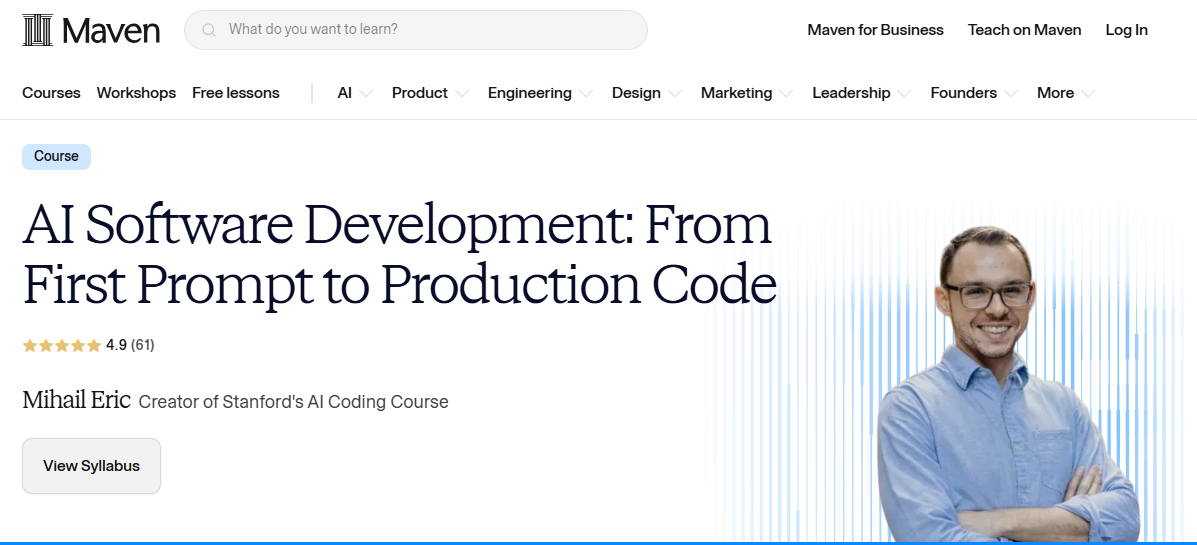

Description
Mihail Eric – AI Software Development Review
Introduction
Artificial intelligence has rapidly transformed the software industry, changing how developers design, build, test, and deploy applications. As organizations increasingly integrate AI into their products and workflows, software engineers are expected to understand not only traditional programming concepts but also modern AI development practices.
Mihail Eric – AI Software Development focuses on the intersection of software engineering and artificial intelligence. Rather than treating AI as a standalone subject, the program explores how AI technologies fit into real-world software development, helping developers understand practical implementation, scalable architecture, and modern engineering workflows.
This review explores the major topics, learning objectives, advantages, and ideal audience for the course.
Course Overview
The course introduces practical AI software engineering principles that combine programming fundamentals with machine learning concepts. Instead of focusing exclusively on theoretical AI, the material emphasizes building production-ready AI applications.
Students learn how AI models can be integrated into software systems while following established software engineering best practices such as modular design, testing, deployment, version control, and maintainability.
The curriculum aims to bridge the gap between software engineering and artificial intelligence, making it valuable for developers who want to expand their technical capabilities.
What You’ll Learn
The course covers multiple areas involved in AI-powered software development.
AI Fundamentals
Learners begin with foundational concepts behind artificial intelligence, including:
- Machine learning basics
- Neural networks
- Model inference
- Training concepts
- Data preparation
- Feature engineering
- AI workflows
These topics establish the knowledge necessary before building AI applications.
Software Engineering Principles
Strong engineering practices remain essential throughout AI development.
Key concepts include:
- Clean code architecture
- Design patterns
- Object-oriented programming
- Modular application design
- Testing strategies
- Documentation
- Version control
- Maintainable codebases
Understanding these principles helps developers create AI software that remains reliable as projects grow.
Building AI Applications
One of the strengths of the material is its practical focus.
Students discover how AI components can be integrated into complete applications instead of existing only inside notebooks or research environments.
This includes:
- Backend integration
- API development
- AI-powered automation
- Intelligent workflows
- Production deployment
- Application scalability
Working with Modern AI Models
Modern software increasingly relies on advanced AI models.
The course introduces practical workflows for using modern AI technologies while explaining considerations such as:
- Performance
- Latency
- Cost optimization
- Reliability
- Security
- Monitoring
Production Deployment
Building an AI model represents only part of the development lifecycle.
The course also discusses production concerns including:
- Model deployment
- Monitoring
- Updating AI systems
- Error handling
- Scaling applications
- Continuous improvement
These skills are essential for real-world software development.
Practical Skills Developed
Students completing the material can strengthen skills such as:
- AI software architecture
- Backend engineering
- API integration
- Machine learning workflows
- Software testing
- Production deployment
- Performance optimization
- Application maintenance
- AI system design
- Engineering best practices
These capabilities are increasingly valuable across modern technology companies.
Learning Experience
The educational approach balances theory with implementation.
Rather than overwhelming learners with mathematical formulas, the content emphasizes understanding concepts through practical examples and software development workflows.
This makes complex AI topics easier to understand while maintaining technical depth.
Projects and demonstrations reinforce important concepts throughout the learning process.
Who Should Take This Course?
The material is suitable for a wide range of technical learners.
It is especially helpful for:
- Software engineers
- Backend developers
- Full-stack developers
- Computer science students
- Machine learning beginners
- AI enthusiasts
- Technical founders
- Engineering managers
- Developers transitioning into AI
Even experienced programmers may discover valuable insights into modern AI engineering practices.
Real-World Applications
The knowledge can be applied across many industries.
Examples include:
Intelligent Chat Applications
Developers learn concepts that support conversational interfaces and intelligent assistants.
Business Automation
Organizations increasingly automate repetitive tasks using AI-powered software.
Enterprise Software
Businesses integrate AI into existing products to improve efficiency and user experience.
Data Analysis
AI enables faster processing of structured and unstructured information.
Recommendation Systems
Modern applications frequently personalize user experiences using AI models.
Workflow Automation
Developers can build systems that intelligently process requests and automate decision-making.
Advantages of Learning AI Software Development
AI development combines multiple disciplines into one modern skill set.
Benefits include:
- Strong software engineering foundation
- Practical AI implementation
- Modern development workflows
- Production-ready techniques
- Scalable application design
- Better understanding of AI systems
- Improved developer productivity
- Career growth opportunities
- Increased technical versatility
Strengths of the Course
Several aspects make the material appealing.
Practical Focus
The emphasis remains on building usable software rather than isolated experiments.
Engineering Mindset
The curriculum consistently applies professional software engineering practices.
Industry Relevance
Topics align with current trends in AI application development.
Balanced Learning
Theory and implementation are presented together, making the content approachable while remaining technically meaningful.
Modern Techniques
The course reflects current AI development practices that developers encounter in professional environments.
Skills That Complement This Course
Students may also benefit from learning:
- Python programming
- Git and GitHub
- REST APIs
- Docker
- Cloud platforms
- SQL databases
- Software architecture
- Machine learning fundamentals
- Prompt engineering
- Large language model integration
Together, these skills create a well-rounded AI engineering toolkit.
Career Opportunities
Knowledge gained from AI software development can support roles such as:
- AI Software Engineer
- Machine Learning Engineer
- Backend Developer
- Full-Stack Developer
- AI Application Developer
- Solutions Engineer
- Technical Consultant
- Platform Engineer
- Software Architect
- Automation Engineer
As AI adoption continues to expand, professionals with both engineering and AI expertise remain in high demand.
Tips for Success
To maximize learning outcomes:
- Practice coding consistently.
- Build small AI-powered applications.
- Experiment with different software architectures.
- Study production deployment concepts.
- Review documentation regularly.
- Test applications thoroughly.
- Focus on maintainable code.
- Continue exploring emerging AI technologies.
Practical experience is the fastest way to reinforce new concepts.
Frequently Asked Questions
Is this course beginner friendly?
Learners with basic programming knowledge should be able to follow along, although familiarity with Python and software development concepts is helpful.
Does it focus only on AI theory?
No. The emphasis is on applying AI within real software engineering workflows.
Who benefits the most?
Software developers who want to integrate artificial intelligence into modern applications will likely find the material valuable.
Does it discuss production deployment?
Yes. Production considerations, scalability, and maintainability are important themes throughout the learning journey.
Is AI software development a growing career field?
Yes. Organizations across industries continue investing in AI-powered applications, increasing demand for engineers with practical AI development skills.
Final Review
Mihail Eric – AI Software Development presents a practical introduction to building modern AI-powered software while maintaining strong software engineering principles. Rather than viewing AI as an isolated discipline, the course demonstrates how intelligent systems fit into scalable, maintainable, and production-ready applications.
For developers interested in combining programming expertise with artificial intelligence, the material provides a structured learning path that covers both foundational concepts and practical implementation strategies. Its emphasis on real-world software engineering makes it particularly relevant for professionals preparing to work on modern AI-enabled products.
Whether your goal is to broaden your technical knowledge, understand AI integration, or strengthen your software engineering workflow, this course offers a comprehensive overview of the skills involved in contemporary AI software development.




Reviews
There are no reviews yet.